
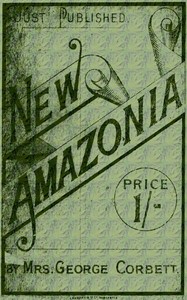
New Amazonia: A Foretaste of the Future by Mrs. George Corbett
Let's break down this fascinating trip to the future. The story is straightforward but packed with ideas. Our narrator, Elizabeth, is a late-Victorian woman fed up with the limitations placed on her sex. In a moment of despair, she drinks a powerful narcotic and wakes up centuries later. She finds herself in New Amazonia, a nation founded by women who fled a war-torn, male-dominated Europe. The men are gone—the book is pretty vague on the specifics, but it's clear they're not part of the picture.
The Story
Elizabeth becomes a tourist in this strange new world. A guide shows her around, and we see everything through her astonished eyes. New Amazonia is a technological marvel: clean, efficient, and peaceful. They have advanced medicine, communal living, and have outlawed things like alcohol, tobacco, and even traditional marriage. Crime is nearly nonexistent. The society is built on principles of rationalism, maternal care, and absolute equality among women. The plot is really a tour of this society, with Elizabeth comparing its wonders to the flaws of her own 19th-century England. The central tension comes from her wrestling with this vision. Is this cold, logical perfection actually better than the messy, familiar world she left behind?
Why You Should Read It
What grabbed me wasn't the action, but the sheer audacity of the premise. Written in 1889, this is one of the earliest full-blown feminist utopias. Reading it, you feel the author's pent-up frustration and wild hope for what women could achieve if just given the chance. It's not a subtle book—it's a passionate manifesto disguised as a novel. The descriptions of technology (like voice-recorded books and air travel) are fun glimpses into what a Victorian imagined the future would hold. But the real heart is in the social critique. It holds a mirror up to the author's own time and asks, 'What if we just started over and did things completely differently?'
Final Verdict
This book is a hidden gem for anyone interested in the roots of science fiction or feminist literature. It's perfect for readers who love classic utopian/dystopian stories like Herland or Looking Backward, but want to see an earlier, grittier version of the idea. Don't go in expecting nuanced characters or a twisting plot—go in for the bold ideas and the historical thrill of seeing a woman from the 1880s blueprint her own radical future. It's a short, provocative, and surprisingly engaging read that proves some questions about society and power are timeless.
This title is part of the public domain archive. It is now common property for all to enjoy.






Sandra Martin
1 year agoBased on the summary, I decided to read it and the narrative structure is incredibly compelling. I couldn't put it down.